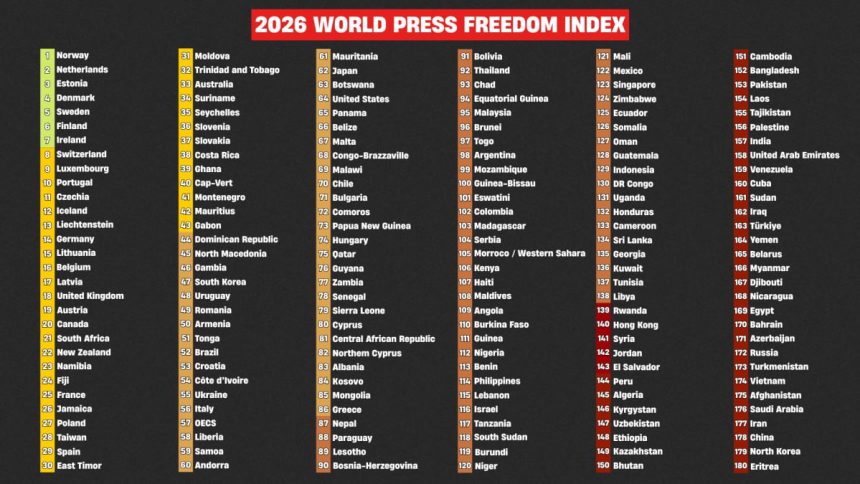
Reporters Without Borders released its annual World Press Freedom Index for 2026, revealing Syria's unprecedented advancement. The country achieved a significant leap of 36 places in the global ranking, marking a historic improvement for Syria in the assessment of press freedom conditions. This notable shift comes after a period of considerable challenges for media professionals within the nation. The latest index provides a detailed evaluation of the environment for journalists, noting specific changes that have contributed to Syria's improved standing.
Dramatic Improvement Detailed
Syria has advanced to rank 141 in the 2026 World Press Freedom Index, marking a notable shift in its global standing. This new position represents a significant upward trajectory compared to its previous performance. The legislative framework in many countries within the region has experienced a significant decline, but it has emerged as a primary factor in enhancing the conditions for practicing journalism in Syria. This development contrasts sharply with broader regional trends and notes specific, positive changes within the country's legal environment affecting media professionals. The improvement in Syria's legislative framework is cited as a key contributor to its positive movement in the index, providing a more conducive environment for reporting and media operations.
Reasons for the Shift
The Reporters Without Borders report attributes Syria's advancement to the fall of Bashar al-Assad's dictatorial regime. The report states, "Syria achieved an unprecedented advance of 36 places after the fall of Bashar al-Assad's dictatorial regime, after years spent on the list of the ten worst countries in the world in terms of press freedom." This key political change is presented as the foundational element enabling broader improvements in media freedom. The end of the dictatorial rule has evidently paved the way for reforms and a more open atmosphere for journalists.
According to the report, Syria recorded a notable improvement across five indicators: political, economic, legislative, social, and security. Each of these areas has shown progress, contributing to the overall enhancement of press freedom. The legislative framework, in particular, has become the primary driver for improving conditions for practicing journalism in Syria, contrasting with a general decline in legal frameworks across most countries in the region. This specific focus on legislative reform shows the commitment to establishing a more strong legal foundation for media operations. The report notes that "Syria recorded a remarkable improvement in the five indicators, namely the political, economic, legislative, social, and security indicators, especially the legal framework, which is dramatically declining in most countries in the region, and which has become the main lever for the development of conditions for practicing the profession in Syria." These full improvements suggest a concerted effort to foster a more supportive environment for independent media.
Context and Previous Standing
Syria's recent advancement marks a significant departure from its previous standing in the World Press Freedom Index. In the 2025 edition of the index, the country was ranked 177 globally. This previous position placed Syria among the lowest-ranked nations worldwide for press freedom, reflecting a challenging and often hostile environment for journalists and media organizations. The current leap of 36 places to rank 141 represents an unprecedented shift compared to its historical performance in the annual assessment by Reporters Without Borders. This substantial alteration in the conditions affecting media professionals within the country demonstrates a profound change in the operational landscape for news gathering and dissemination. The improvement signals a move away from the severe restrictions and dangers that previously characterized the Syrian media environment.
Broader Implications
Syria's significant leap in the 2026 World Press Freedom Index reflects broad improvements across multiple areas, indicating a full and systemic transformation. The country recorded notable progress in the political, economic, legislative, social, and security indicators, demonstrating a holistic approach to fostering media freedom. This full enhancement suggests a systemic shift in the environment for journalists and media operations within Syria. The positive changes across these diverse categories point to a foundational transformation influencing the conditions for practicing journalism, promising a more open and secure future for media professionals.