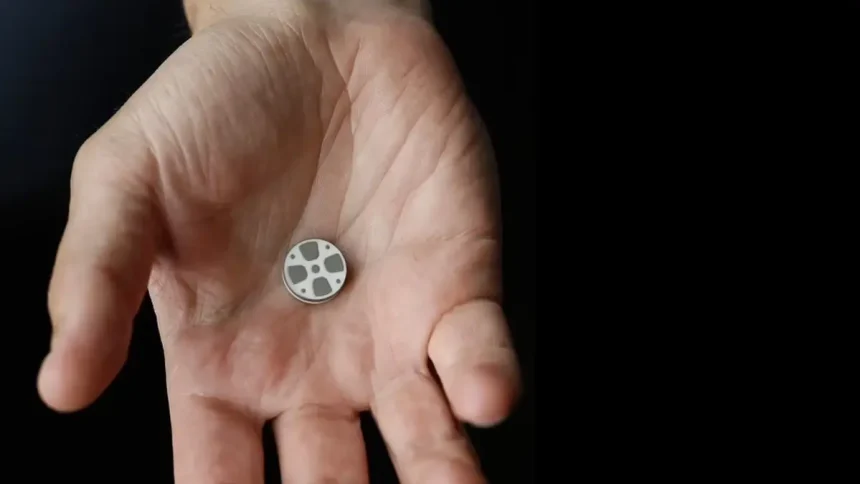
Motif Neurotech has received approval from U.S. Health authorities for its RESONATE Early Feasibility Study, initiating the first human clinical trials for its wireless brain device. This device is designed for implantation inside the skull, resting atop the brain's dura mater without penetrating brain tissue. The study aims to confirm the safety of both the device and the implantation procedure over a 12-month period, while also measuring initial indicators of effectiveness. Motif Neurotech’s innovation targets patients suffering from treatment-resistant depression, a condition that affects nearly 3 million Americans. Reports indicate the device, referred to as the DOT, is approximately the size of a blueberry.
Motif's Wireless Implant Technology
The new device relies on a technology known as "Programmable Digital Brain Therapy (DOT)" and operates completely wirelessly, without implanted batteries or wires. Reports indicate the XCS system is also being developed to monitor brain signals, aiming to provide objective measures for personalized therapy. Prior peer-reviewed publications demonstrated the device's ability to safely and effectively stimulate the human brain without contacting its surface. In 2024, Motif released a working paper showing the device could be safely implanted in mice, with human trials beginning by testing an advanced sensor without embedded neurons inside a living human brain.
Science Corporation, founded by former Neuralink president Max Hodak, is also preparing to place its first sensor in a human brain, having completed a $230 million Series C fundraising round last month. Science’s approach uses a biohybrid interface combining lab-grown neurons with electronics. Yale Medical School’s Dr. Murat Günel is in discussion with medical ethics boards for human clinical trials, believing patient candidates for initial trials may include stroke victims requiring significant brain surgery. Dr. Günel stated, "The idea of using natural connections through neurons and creating a biological interface between the electronics and the human brain is genius." He added, "I imagine this biohybrid system as combining those two — you have the electronics, and you have the biological system. In Parkinson’s, for example, we cannot stop the progression of the disease; in neurosurgery, all we are doing is putting an electrode to stop the tremors. Whereas if you can really put the [transplanted] cells back in the brain, protect those circuits, there’s a chance, and I believe it’s a good chance, that we can stop progression of the disease." Dr. Günel believes this biohybrid system might provide more effective treatments for conditions like Parkinson’s disease. PRIMA plans to be more widely available in Europe once regulatory approval is obtained, perhaps as soon as 2026.
Clinical Trial Details and Goals
The first phase of clinical trials for the RESONATE study will be conducted across up to eight leading medical institutions, supported by an initiative from the Advanced Research Projects Agency for Health (ARPA-H). Researchers will track reductions in depression symptoms using clinical assessments, alongside monitoring quality of life, anxiety, and cognitive function. The RESONATE study expands upon over 10 years of foundational research from The Robinson and Yang Labs at Rice University, with prior research receiving support from DARPA, ARPAH, and the NIH BRAIN Initiative.
Dr. Murat Günel, chair of Yale Medical School’s Department of Neurosurgery, has joined Science Corporation as a scientific adviser. Science Corporation, co-founded by Max Hodak, who previously co-founded Neuralink, was recently valued at $1.5 billion following its Series C funding round. Alan Mardinly, co-founder and chief science officer, leads a team of 30 researchers developing Science's biohybrid sensor. The device contains 520 recording electrodes packed into an area the size of a pea. Dr. Günel stated, "The idea of using natural connections through neurons and creating a biological interface between the electronics and the human brain is genius." He added that one early use could be delivering gentle electrical stimulation to damaged brain or spinal cord cells to encourage healing.
Company Milestones and Future Scope
The DOT device from Motif Neurotech is designed to be wirelessly powered and implanted in a 20-minute outpatient procedure. The trial will evaluate the Motif XCS System, also known as the DOT, which is a small, wirelessly powered implant engineered for precision and practicality. This Investigational Device Exemption (IDE) approval was granted only four years after Motif Neurotech's founding, making it the fastest implantable Brain-Computer Interface (BCI) company to move from inception to IDE approval with a novel device. Motif Neurotech is also exploring the use of the DOT for applications in Bipolar Disorder, Obsessive-Compulsive Disorder (OCD), Alzheimer’s Disease, and Substance Use Disorder.
Science Corporation, founded in 2021, acquired the technology for its PRIMA device, intended for restoring vision, in 2024. Reports indicated that conventional brain interfaces often use metal probes or electrodes that can cause brain damage. Science's final device will be embedded with lab-grown neurons. Science does not plan to seek FDA approval for its initial trials, according to reports. A more complex application of their technology might involve monitoring neurological activity in patients with brain tumors and providing early warnings about seizures.