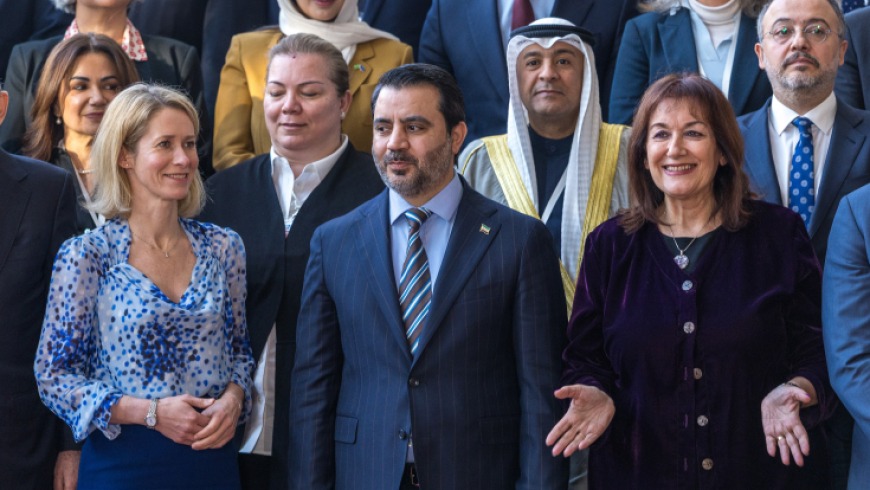
The International Cooperation Department at Syria's Ministry of Foreign Affairs and Expatriates convened a meeting on Tuesday, May 12. The meeting was held at the ministry’s headquarters with a delegation representing 23 donor countries to the UN Office for the Coordination of Humanitarian Affairs (OCHA). The discussions focused on strengthening international support for Syria’s sustainable development track. Participants also addressed national recovery priorities, aiming to bolster the country's reconstruction efforts and facilitate a transition from humanitarian aid dependence to sustainable development.
Prioritizing National Ownership
The delegation was expected to meet with government bodies and international organizations to discuss improving aid distribution and strengthening partnerships. Mohammed Bateesh, head of the UN Cooperation Section, stated that the Syrian leadership places particular emphasis on expanding partnerships with countries willing to support recovery efforts in line with national priorities. Bateesh explained that the current stage requires shifting from reliance on humanitarian aid toward supporting recovery and reconstruction projects, with priority given to restoring essential services and creating conditions for the return of displaced people to their original areas. The recovery approach is based on "full national ownership" of the recovery process, according to Bateesh. This principle shows Syria's commitment to directing its own development path. The "No to Camps" initiative supports voluntary return through rehabilitating infrastructure and services, emphasizing the importance of sustainable reintegration. International partners are called upon to adopt an integrated approach that links humanitarian action with development, ensuring long-term stability and progress. More than 90 international NGOs have been approved for registration by the Syrian government, indicating a willingness to collaborate with international partners who align with national objectives.
Focus on Essential Services
Syria is prioritizing the restoration of essential services and the establishment of conditions conducive to the return of displaced individuals to their original areas. Officials emphasized the urgent need to expand recovery projects in regions experiencing accelerated returns. There is an urgent need to scale up recovery projects in areas witnessing accelerated returns, particularly in the health, education, water, and electricity sectors. These efforts are particularly focused on the health, education, water, and electricity sectors to ensure basic necessities are met. Maarat al-Numan, for instance, has seen rapid returns despite the continued absence of basic services in the area, noting the critical need for immediate infrastructure rehabilitation. Authorities underlined that restoring essential services in these return areas should be treated as an urgent humanitarian priority to support population re-establishment and prevent further displacement. The government aims to create an environment where returnees can rebuild their lives with adequate access to vital services.
Financial Sector Reforms
The Central Bank of Syria continues to implement financial-sector reforms, including the development of anti-money-laundering and counter-terrorism-financing systems. The bank is also working diligently to reintegrate Syria’s banking sector into the global financial system. The aim of this reintegration is to improve compliance with international standards and facilitate the country's exit from the Financial Action Task Force (FATF) 'grey list'. These efforts are part of broader initiatives to stabilize and modernize the financial landscape, aiming to enhance transparency and attract much-needed investment for national recovery. Improving financial compliance is seen as a key step towards rebuilding international trust and economic stability.
Donor Engagement and Aid
A delegation representing 23 donor countries to the UN Office for the Coordination of Humanitarian Affairs (OCHA) met at the Ministry of Foreign Affairs and Expatriates' headquarters. This high-level delegation had entered Syria through the Nassib border crossing the previous day, marking a significant visit for international engagement. Syrian officials stated that humanitarian access had been facilitated across various regions, including the entry of dozens of aid convoys into Sweida during emergency periods. This facilitation of access demonstrates Syria's commitment to ensuring aid reaches those in need. The discussions with the donor countries aimed to foster greater cooperation and ensure that international assistance is effectively channeled towards Syria's recovery and reconstruction priorities.