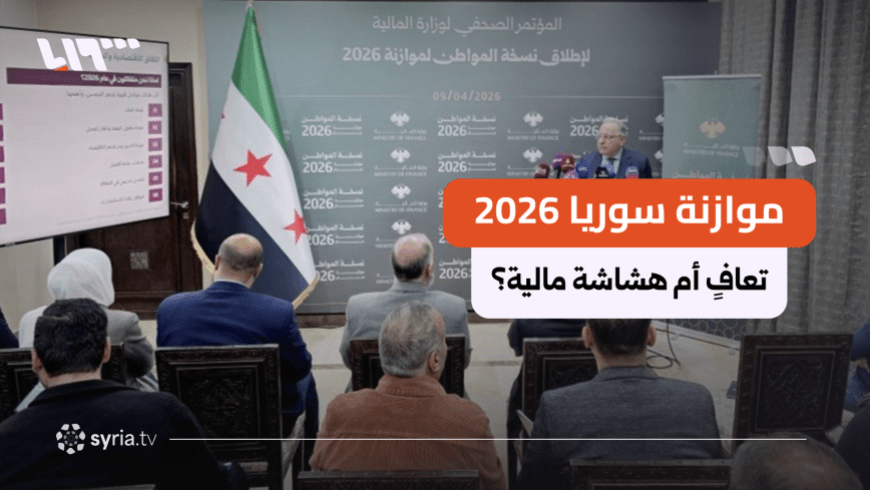
Syria's Ministry of Finance released its first-half 2026 budget report, indicating a fiscal deficit exceeding $1 billion during the first six months of the year. This substantial deficit, recorded between January and June 2026, notes significant financial pressures on the Syrian government. The report, which details the government's financial performance, comes amidst a significant increase in budget figures. The overall budget volume for the first half of 2026 represents an 111 percent increase compared to the same period in the previous year, showing a rapid expansion of both income and expenditure. This substantial rise in both revenues and expenditures has led to a considerable budget gap, as outlined in the official figures from the Damascus-based ministry. Public revenues, in particular, rose to $2.7 billion in the first half of 2026. This figure represents a notable 111 percent increase compared to the corresponding period in the previous year, demonstrating a strong growth in the state's income generation capabilities. However, this revenue growth was outpaced by government spending, which surged by an even larger margin. Spending reached $3.7 billion in the first six months of the year, representing a 331 percent increase over the same period last year, leading directly to the reported deficit.
Revenue and Spending Breakdown
Customs duties were a significant revenue generator for the Syrian government during the first half of 2026, bringing in $1.1 billion. This figure accounted for approximately 40 percent of the total revenue reported by the Ministry of Finance, showing the government's reliance on trade tariffs for income. Oil and gas revenues also contributed substantially to the state's coffers, totaling $601 million over the six-month period. This revenue stream, while significant, represents a smaller portion of the overall income compared to customs duties.
Direct and indirect taxes formed a smaller portion of the overall income, representing 9 percent of the total. This amounted to $252 million in tax revenue. This indicates that the current tax system, as it stands, contributes less to the state's finances than other sources. State investments provided an additional $763 million to the government's revenue streams, reflecting returns or proceeds from state-owned enterprises or capital deployments. The diverse sources of revenue, including customs, oil and gas, taxes, and state investments, reflect the government's efforts to generate income across various sectors to fund its operations and projects.
On the expenditure side, investment spending reached $1.02 billion during the first half of the year. This allocation suggests a focus on capital projects and long-term development initiatives, despite the overall budget deficit. The report also indicated that monthly public expenditures averaged $617 million. These figures highlight the areas of both income generation and financial outflow for the Syrian government as detailed in the Ministry of Finance's report. The diverse sources of revenue reflect the government's efforts to generate income across various sectors, while the expenditure figures illustrate the allocation of funds towards both ongoing public services and capital projects. The substantial investment expenditures suggest a focus on long-term development or infrastructure, despite the overall budget deficit, aiming to stimulate economic activity or improve public services.
Economic Context and Challenges
Syria's financial landscape reflects a significant imbalance between income and expenditure, according to recent analysis. Economist Radwan al-Dibs stated that "for every $100 in revenue, the state spent $137," noting the disparity between the government's income and its financial obligations. This spending pattern has contributed directly to the over $1 billion fiscal deficit observed in the first half of 2026. A substantial portion of government outlays has been directed towards operational costs rather than long-term development. Economist Mohammad Oulabi noted that "64 percent of total spending went to administrative operations and civil-service payrolls, rather than long-term capital investment or social protection." This allocation of funds indicates a focus on maintaining existing governmental structures and public sector employment, which can limit resources available for growth-oriented investments.
Looking ahead, tax collections are typically expected to increase during the second half of the year. This seasonal trend could provide some relief to the state's financial position. However, the central fiscal challenge for the remainder of 2026 involves a necessary transition from customs-based revenue, which has been a major contributor to the state's income, to a more sustainable, production-driven tax system. This shift is key for diversifying the revenue base and reducing reliance on volatile trade-related income. The Ministry of Finance has projected that total revenues could approach $8 billion by the end of 2026. This projection suggests an anticipated improvement in the state's financial intake, despite the current deficit and the challenges associated with shifting economic strategies, indicating an optimistic outlook for the latter half of the year.
Expert Analysis and Implications
Public revenues in Syria rose to $2.7 billion during the first half of 2026. This increase in state income, representing an 111 percent rise compared to the same period last year, was accompanied by a significant surge in expenditures, with spending reaching $3.7 billion in the first six months of the year, representing a 331 percent increase. This stark difference between revenue growth and expenditure growth shows the fiscal pressures facing the government. The allocation of these funds notes key areas of government outlay.
A substantial portion of total spending, 36 percent, was directed towards salaries and wages, amounting to $1.34 billion. This significant expenditure on public sector compensation reflects a major ongoing commitment for the government. Additionally, administrative costs reached $1.03 billion over the same period, indicating the substantial overhead associated with government operations. The government also allocated $315 million to social subsidies, demonstrating an effort to support its citizens through various social protection programs. These figures contribute to the overall fiscal picture revealed by the Ministry of Finance's mid-year budget report for 2026, illustrating the challenges of balancing essential public services and administrative costs with the need for sustainable revenue generation and long-term investment. The report's findings emphasize the urgent need for fiscal reforms to address the widening gap between income and expenditure and to foster a more resilient economic foundation for the country.