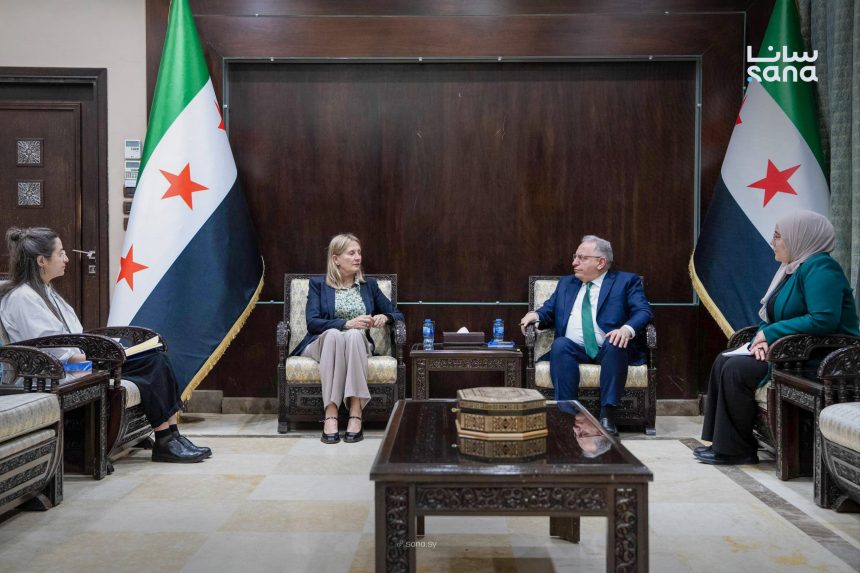
Norway announced Friday, May 1, it was easing its investment ban on Syrian assets, signaling a potential shift towards economic re-engagement with the nation. Syrian Finance Minister Mohammed Yisr Barnieh met with Norwegian Ambassador to Syria Hilde Haraldstad to discuss reconstruction support and enhanced economic cooperation between the two countries. Barnieh welcomed Norway's decision to lift a ban on investment in Syrian assets and bonds.
Norway is lifting the ban on investments in Syrian government bonds by its $2.2 trillion wealth fund. This decision came after Iran was included on the list of countries covered by a government bond exemption, and Syria was subsequently removed from the restricted list, according to reports. Officials said the move signals support for the government of Syrian President Ahmed al-Sharaa, which took power in late 2024.
Details of the Meeting
The discussions between Syrian Finance Minister Mohammed Yisr Barnieh and Norwegian Ambassador Hilde Haraldstad reviewed previous talks with Norwegian officials. Focus during the meeting was placed on potential Norwegian contributions to reconstruction projects and the "Syria Without Camps" initiative. Barnieh characterized Norway's decision as a positive step towards expanding economic cooperation and supporting recovery efforts in the coming phase. A Norwegian government document, released on April 15, indicated Oslo was considering easing restrictions on its sovereign wealth fund’s investments in Syrian government bonds. This consideration signals gradual re-engagement with Syria’s financial sector.
Norway's Financial Shift
The ban on investment in Syrian assets and bonds was originally imposed by Norway's Ministry of Finance and the country’s sovereign wealth fund. Reports indicated that the Norwegian wealth fund, which is the world's largest sovereign wealth fund, invests state revenues from oil and gas production in stocks, bonds, property, and renewable energy projects abroad. Currently, 26.5% of its investments are held in fixed income, primarily in the United States, Japan, and Germany. The fund has no fixed-income holdings in any Middle Eastern countries, according to fund data.
A new assessment regarding states covered by the government bond exemption was made, according to minutes from a January 28 meeting. "The Ministry ... Informed that a new assessment has been made of which states are covered by the government bond exemption," the minutes stated. The 2025 white paper identified North Korea, Syria, Russia, and Belarus on the exclusion list for government bonds, while the latest government white paper, presented to parliament on March 27, includes Iran, North Korea, Russia, and Belarus on that list. Norway is reportedly planning to forbid the world's largest sovereign wealth fund from investing in Iranian government bonds.
Broader Implications for Syria
The Norwegian decision represents another step in Syria's re-entry into global finance, according to reports. This follows the lifting of the most stringent U.S. Sanctions on Syria in December. Syria's reintegration into the global financial system also includes reactivating the central bank's account at the Federal Reserve Bank of New York, marking its first use since 2011. The Norwegian fund's decisions have often set precedents for other financial entities; for example, its choice to divest from companies generating 30% or more of their revenue from coal production was widely emulated.