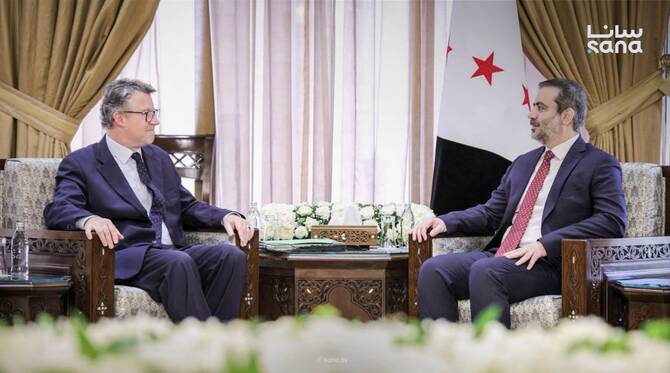
The first session of a Syrian-German Joint Committee convened in Damascus on Thursday to address Syria’s economic recovery. The committee’s inaugural meeting was co-chaired by Asaad Al-Shaibani, the foreign minister of the Syrian Arab Republic, and Geza Andreas von Geyr, German minister of state at the Federal Foreign Office. The joint initiative aims to facilitate efforts toward the country's reconstruction and foster direct flights between the two nations. This significant diplomatic step marks a new chapter in the relationship between Germany and Syria, focusing on practical cooperation for the benefit of both countries.
Areas of Cooperation Explored
The joint committee is mandated to foster cooperation across a broad spectrum of areas, according to officials familiar with the discussions. These include economic recovery, reconstruction, and investment initiatives aimed at revitalizing Syria's infrastructure and economy. The focus on economic recovery is critical for Syria, which has faced significant challenges in recent years. Discussions will also encompass energy and transport sectors, alongside efforts to establish direct civil aviation links between Germany and Syria. These infrastructure developments are seen as foundational to long-term stability and growth. The committee will address sensitive issues such as transitional justice, the search for missing persons, and full approaches to refugee issues. The inclusion of transitional justice shows a commitment to addressing past grievances and fostering reconciliation. The search for missing persons is a deeply humanitarian concern for many families, while managing refugee issues is a shared priority for both nations given the large Syrian diaspora. This multi-faceted agenda reflects a concerted effort to tackle both immediate recovery needs and long-term stability between the two nations, demonstrating a full approach to bilateral relations.
Direct Flights and Aviation Ties
The nations signed an air transport agreement designed to enhance coordination between their respective civil aviation authorities. This agreement is intended to meet the necessary requirements for establishing direct flights between Germany and Syria. The formal signing of this agreement represents a key step towards re-establishing regular air travel. German authorities are currently reviewing the potential lifting of existing restrictions on direct flights to and from Damascus. This change is anticipated to occur after July 27, according to official statements. The resumption of direct flights would significantly ease travel for individuals and facilitate business connections, contributing to the broader economic recovery efforts. The move signifies a step towards normalizing aviation links, which have been a key point of discussion for the joint committee and a practical outcome of these renewed diplomatic efforts.
Broader Context and Refugee Issues
Syrian President Ahmad Al-Sharaa met with Germany’s Chancellor Friedrich Merz and President Frank-Walter Steinmeier in March to discuss potential investments and the repatriation of refugees. These high-level discussions between the leaders preceded the recent joint committee formation, laying the groundwork for the current cooperative initiatives. The meetings in March noted the mutual interest in addressing both economic opportunities and humanitarian challenges. Flights between Syria and all European cities, with the exception of Moscow, were suspended during the civil war. This conflict began in 2011 and concluded with the fall of President Bashar Assad and his regime in December 2024, leading to widespread disruption of international travel to and from Syria. Germany currently hosts at least 1 million Syrian refugees. This figure represents the largest number of Syrian refugees residing in Western Europe, noting the significant diaspora in the country and the humanitarian impact of the conflict. The discussions on refugee repatriation within the joint committee reflect the ongoing importance of this issue for both Germany and Syria, seeking sustainable solutions for those displaced by the conflict.