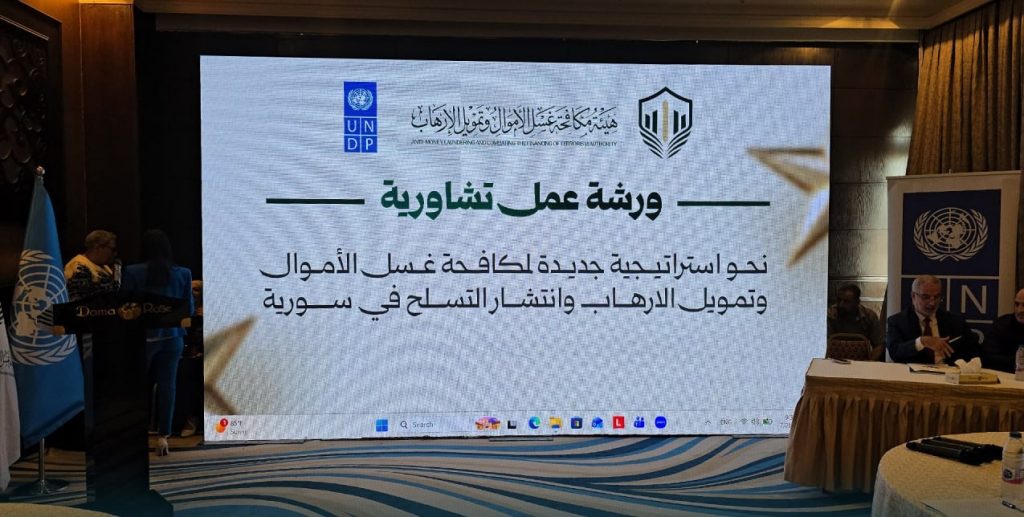
Syria’s Anti-Money Laundering and Counter-Terrorism Financing Authority (AML/CFT) unveiled its National Strategy for Countering Money Laundering, Terrorist Financing, and Proliferation Financing on Tuesday. The United Nations Development Programme (UNDP) partnered with the AML/CFT on the initiative, which launched during an official ceremony at the Dama Rose Hotel in Damascus. The full strategy marks a significant step in the nation's efforts to bolster its financial integrity and combat illicit financial flows. Senior members of the Syrian cabinet attended the event, showing the government's commitment to the new framework. Among the high-ranking officials present were Interior Minister Anas Khattab, Justice Minister Mazhar al-Wais, Finance Minister Mohammad Yusr Barnia, Economy and Industry Minister Mohammad Nidal al-Shaar, and Communications Minister Abdulsalam Haykal. Their presence noted the cross-ministerial importance and collaborative nature of this national undertaking.
"Financial crimes pose a direct threat to national security and the rule of law," Interior Minister Anas Khattab stated during the ceremony. He elaborated on the broad implications of such illicit activities, emphasizing their capacity to destabilize national institutions and undermine public trust. Justice Minister Mazhar al-Wais emphasized that "confronting illicit financial activity is central to protecting society," adding that "successful implementation of the strategy depends on strong international partnerships built on trust and the exchange of expertise." This call for international collaboration noted the global nature of financial crime and the necessity of coordinated responses. Finance Minister Mohammad Yusr Barnia noted the importance of the strategy, saying, "Countering financial crime extends well beyond traditional banking oversight, forming a core pillar of economic stability and institutional performance." He stressed that a strong anti-financial crime framework is fundamental to fostering a resilient economy and ensuring the effective functioning of state apparatus.
Strategy Goals and Vision
Safwat Raslan, Governor of the Central Bank of Syria and head of the Anti-Money Laundering and Counter-Terrorism Financing (AML/CFT) Commission, described the new strategy as an opportunity to unify national vision and enhance coordination among relevant authorities. Raslan stated, "The strategy is a chance to forge a unified national vision and strengthen coordination among relevant authorities." He stressed that improving institutional integration and raising the effectiveness of Syria’s anti-money-laundering framework are essential to safeguarding the national economy, restoring public confidence in state institutions, and creating conditions conducive to investment and sustainable development. This full approach aims to create a more secure and predictable financial environment. He added, "Syria is committed to aligning domestic regulations with international standards, particularly the Financial Action Task Force (FATF) recommendations, as part of ongoing legislative and technical reforms aimed at removing the country from the grey list." This commitment reflects a broader ambition to reintegrate Syria into the global financial system by adhering to internationally recognized best practices.
Ruhi Afghani, a representative involved in the project, explained that the new framework aims to channel financial flows back into formal banking systems. Afghani noted the strategy seeks to establish transparent mechanisms capable of earning both domestic and international trust. This redirection of funds is key for economic recovery and development, ensuring that financial activities contribute to the legitimate economy rather than fueling illicit ventures.
Ministers Detail Threats and Importance
Interior Minister Anas Khattab asserted that financial crimes represent a direct threat to the country's security and legal framework. "Financial crimes pose a direct threat to national security and the rule of law," Khattab stated, reiterating the severe consequences of such activities on national stability and governance. Justice Minister Mazhar al-Wais showed the critical role of tackling illicit financial activities in safeguarding society. He remarked, "Confronting illicit financial activity is central to protecting society, noting that successful implementation of the strategy depends on strong international partnerships built on trust and the exchange of expertise." This emphasis on collaboration with international partners notes the recognition that financial crime is a transnational issue requiring coordinated global efforts. Finance Minister Mohammad Yusr Barnia further explained the broad significance of combating financial crime, noting its impact beyond traditional banking. Barnia stated, "Countering financial crime extends well beyond traditional banking oversight, forming a core pillar of economic stability and institutional performance." He pointed out that effective anti-money laundering and counter-terrorism financing measures are indispensable for maintaining the health and integrity of the national economy.
UNDP Context and Recovery Hopes
UNDP Acting Resident Representative Ruhi Afghani stated that the strategy emerges at a key moment for Syria, following over a decade of financial isolation. Afghani noted the new framework aims to redirect financial flows into formal banking systems and create transparent mechanisms that can garner both domestic and international confidence. "The strategy arrives at a critical juncture after more than a decade of financial isolation," Afghani said. He added, "Recent developments — including the lifting of most economic sanctions and the gradual resumption of trade and investment — are early signs of recovery. The new framework aims to channel financial flows back into formal banking systems and establish transparent mechanisms capable of earning both domestic and international trust." Afghani further noted these developments as indicators of a nascent recovery, suggesting that the strategy is well-timed to capitalize on these positive shifts and accelerate the country's economic rebuilding. He stressed that by fostering transparency and trust, Syria can attract much-needed investment and facilitate legitimate trade.
New Independent Financial Intelligence Unit
The launch of the national strategy follows an announcement on Monday by Safwat Raslan, Governor of the Central Bank of Syria and head of the Anti-Money Laundering and Counter-Terrorism Financing (AML/CFT) Commission. Raslan detailed a rebranding and institutional restructuring that will convert the AML/CFT Authority into an independent entity, which will function as Syria’s primary Financial Intelligence Unit (FIU). This autonomous body will be granted powers to receive and analyze suspicious transaction reports, conduct financial investigations, and refer substantiated cases to the judiciary. The new FIU will also monitor compliance across regulated sectors and facilitate the exchange of information with regional and international counterparts, thereby strengthening Syria's capacity to detect, prevent, and prosecute financial crimes. This move towards an independent FIU aligns with international standards and is expected to significantly enhance the country's ability to combat money laundering and terrorism financing effectively.